> ## Documentation Index
> Fetch the complete documentation index at: https://docs.y.uno/llms.txt
> Use this file to discover all available pages before exploring further.
# Payment Concierge
> Configure your AI-powered payments analyst, ask it anything about your payment data, and manage the channels where your team works with it
The Payment Concierge section within the dashboard sets up an AI agent that works like a payments analyst on your team, one that sees your entire payment stack and works from wherever your team already does: Slack, WhatsApp, or Telegram. It's available 24/7, so you can ask anything, anytime, and get an answer in seconds. For example:
* *"Why did my approval rate drop in the UK this week?"*
* *"Which PSP should I route Mastercard transactions to in Brazil?"*
* *"What's causing my Adyen rejections, and how do I fix them?"*
* *"Compare all my PSPs over the last 7 days: who's underperforming?"*
* *"Build me a full report of last month's approval performance, broken down by country and provider."*
Your Concierge doesn't just answer. It explains the root cause down to the issuer level, recommends a specific action to take, and can turn any of it into a complete report.
Your Concierge can also work proactively. It monitors your payment stack around the clock and sends scheduled **briefings**: daily volume and approval rates, a per-provider breakdown, the top decline reasons, and flags on any anomaly, like an approval rate drop across providers or a sudden volume collapse, each with context and specific next steps. From this section you decide **what** it reports on and how often, and **where** each report is delivered: Slack, WhatsApp, or Telegram.
## Requesting access
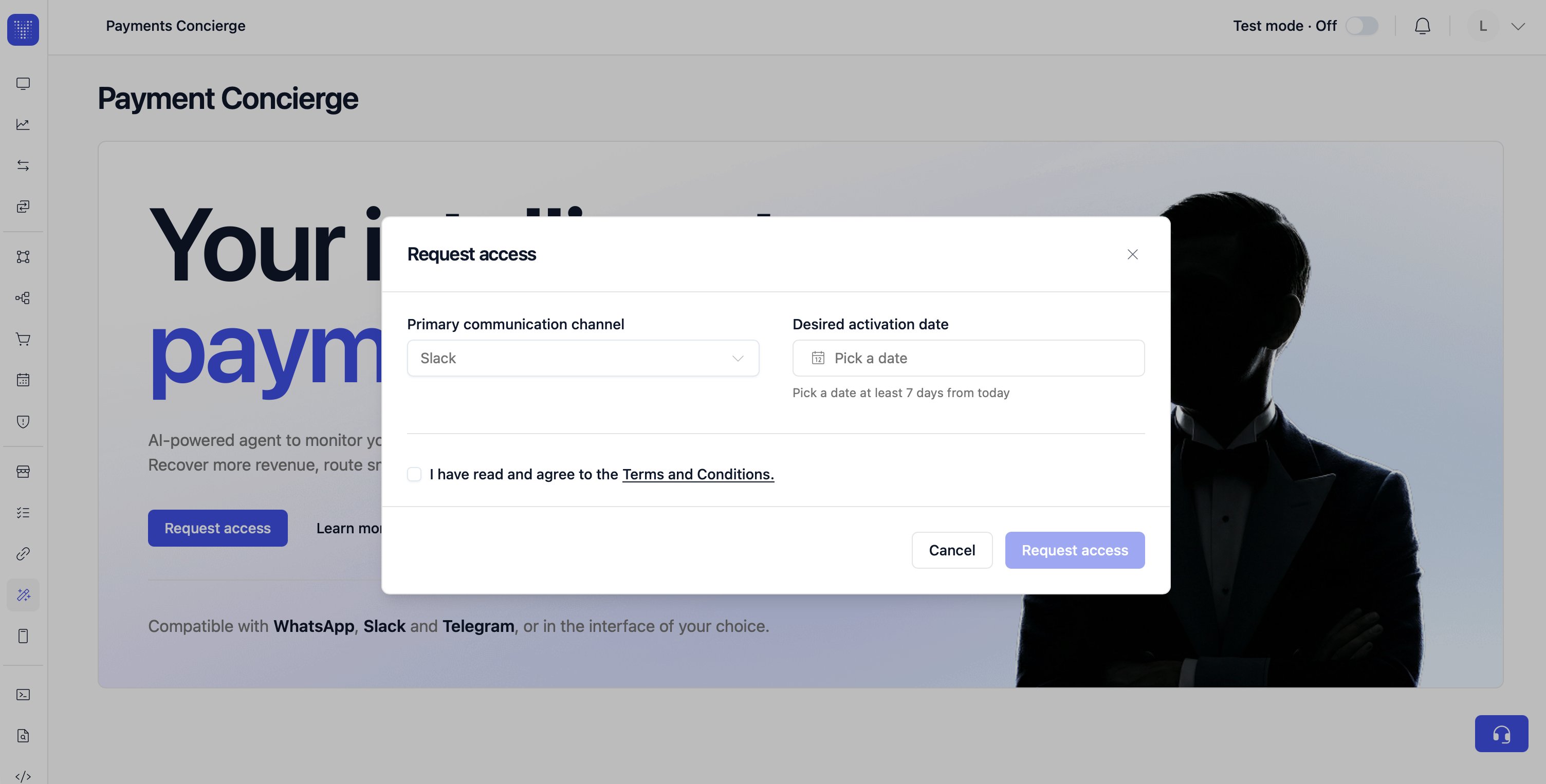
If your organization doesn't have Payment Concierge enabled yet, open the section from the dashboard and click **Request access**. Once your account is enabled, the section updates automatically to show the **Briefing configuration** and **Communication channels** tabs.
 ## Adding a briefing
A briefing is a scheduled report the Concierge sends to your team with the metrics and insights you configure below.
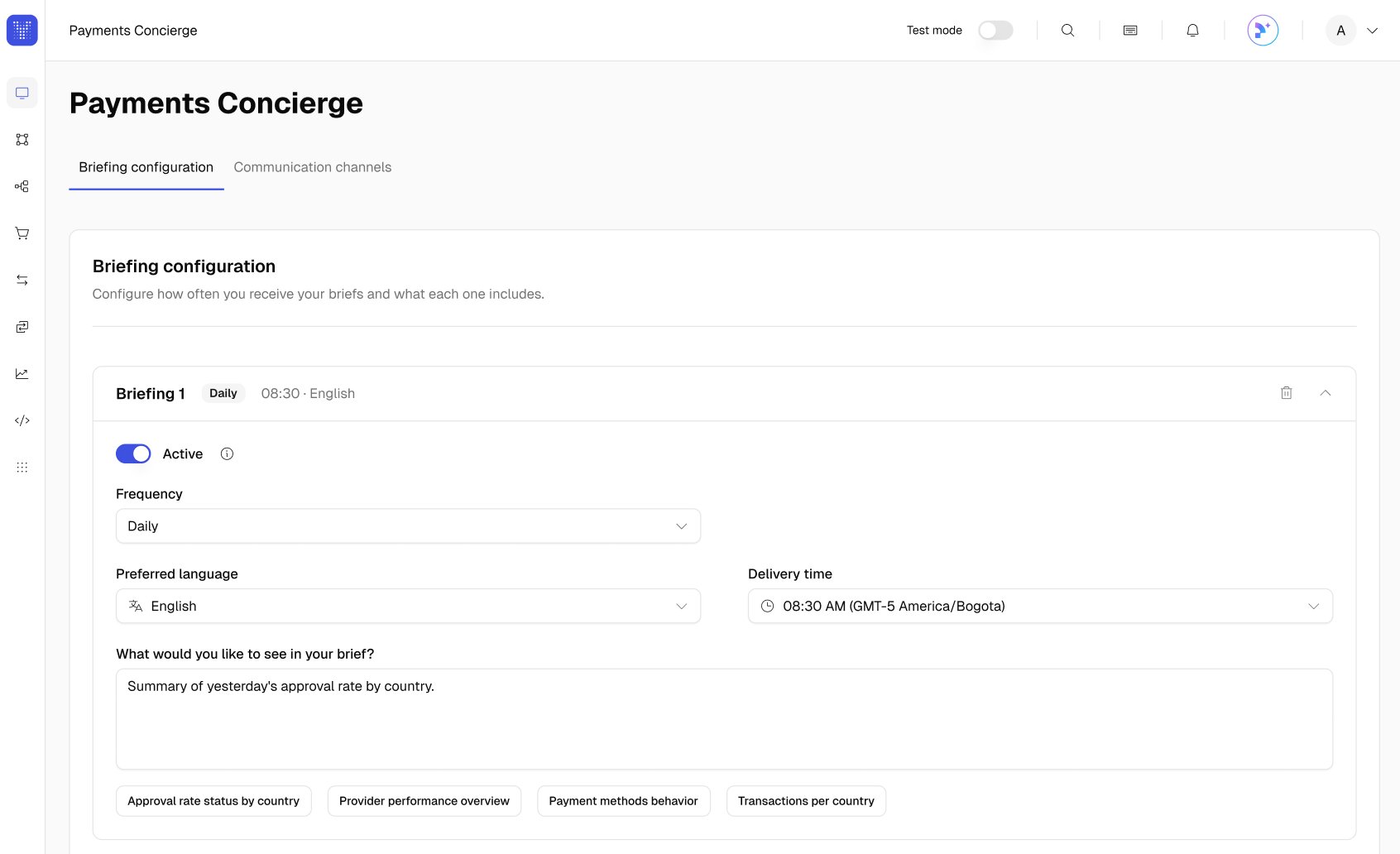
This tab displays by default when opening Payment Concierge in the dashboard. From here you can see the list of briefings your organization already has, and add new ones. Click **Add briefing** to create one. A new briefing card is added to the list with a default name. Click the name at the top of the card to rename it, then press **Enter** to confirm.
Choose a **Frequency**: Daily, Weekly, or Monthly. Then set the corresponding **Day of the week** or **Day of the month** if you picked Weekly or Monthly. Pick a **Preferred language** for the report and a **Delivery time**. The timezone label under the time picker shows the exact offset and identifier being used (for example, UTC-05:00 America/Bogota), so you can confirm the report will arrive at the right local time.
Use the **What would you like to see in your brief?** editor to write plain-language instructions, like "Summary of yesterday's approval rate by country, highlighting drops greater than 5%", or use the formatting toolbar to structure the prompt with headings and bullet lists. To get started faster, click one of the suggestion buttons above the editor: **Approval rate status by country**, **Provider performance overview**, **Payment methods behavior**, or **Transactions per country**. Then edit the loaded template to fit your needs.
Make sure the **Status** switch on the card is set to **Active**, then click **Save changes** at the bottom of the page. The system confirms your changes and the briefing starts being delivered on the next scheduled run.
## Adding a briefing
A briefing is a scheduled report the Concierge sends to your team with the metrics and insights you configure below.
This tab displays by default when opening Payment Concierge in the dashboard. From here you can see the list of briefings your organization already has, and add new ones. Click **Add briefing** to create one. A new briefing card is added to the list with a default name. Click the name at the top of the card to rename it, then press **Enter** to confirm.
Choose a **Frequency**: Daily, Weekly, or Monthly. Then set the corresponding **Day of the week** or **Day of the month** if you picked Weekly or Monthly. Pick a **Preferred language** for the report and a **Delivery time**. The timezone label under the time picker shows the exact offset and identifier being used (for example, UTC-05:00 America/Bogota), so you can confirm the report will arrive at the right local time.
Use the **What would you like to see in your brief?** editor to write plain-language instructions, like "Summary of yesterday's approval rate by country, highlighting drops greater than 5%", or use the formatting toolbar to structure the prompt with headings and bullet lists. To get started faster, click one of the suggestion buttons above the editor: **Approval rate status by country**, **Provider performance overview**, **Payment methods behavior**, or **Transactions per country**. Then edit the loaded template to fit your needs.
Make sure the **Status** switch on the card is set to **Active**, then click **Save changes** at the bottom of the page. The system confirms your changes and the briefing starts being delivered on the next scheduled run.
 With your briefings set, proceed to the **Communication channels** tab to connect the platforms where the Concierge delivers them, if you haven't done so yet.
**Multiple briefings for different audiences**
You can create as many briefings as you need. A common setup runs a short daily approval rate summary for the payment ops team and a longer weekly provider performance report for finance leadership, each in its own language and delivered to a different channel.
**Templates as a starting point**
The four suggestion buttons load detailed multi-paragraph prompts into the editor. These are meant as a starting point. You can edit or extend them before saving. If you have a recurring report format your team already uses, paste it into the editor to replicate it.
### Managing briefings
The **Briefing configuration** tab also lets you manage existing briefings to suit your evolving reporting needs:
* **Editing a briefing**: Update the name, schedule, language, or content of any briefing by clicking on its card to expand it, changing the fields you need, and clicking **Save changes**.
* **Pausing and resuming a briefing**: To temporarily stop delivery without losing the configuration, toggle the **Status** switch on the card to **Inactive**. The card dims to signal it's paused. Toggle it back to **Active** whenever you want deliveries to resume.
* **Deleting a briefing**: If a briefing is no longer needed, click the trash icon on its card to remove it. Deleting a briefing is only available when you have more than one. You always keep at least one briefing on the page.
* **Managing multiple briefings at once**: You can add, edit, pause, and delete several briefings in the same session. All changes are staged locally and only committed to the server when you click **Save changes**.
## Configuring communication channels
Communication channels tell the Concierge where to deliver briefings and where your team can chat with it directly.
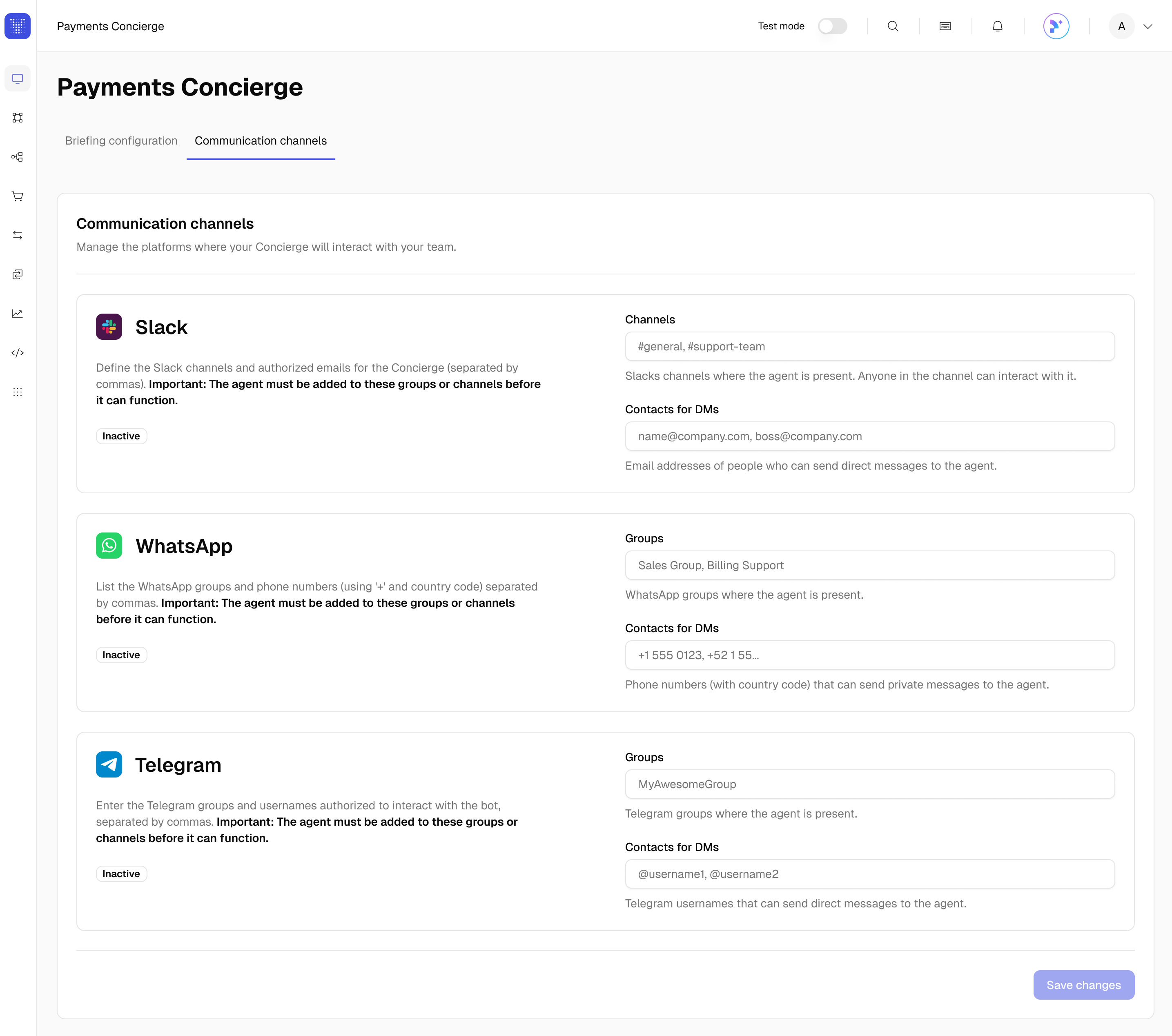
Three platforms are supported: **Slack**, **WhatsApp**, and **Telegram**. Each has its own card. Slack and Telegram support both shared destinations (**Groups** or **Channels**) and **Contacts for DMs** for direct messages, while WhatsApp is set up with **Contacts for DMs** only.
Add the channels and contacts you want to enable. In the **Channels** field, paste a Slack channel URL (for example, `https://your-workspace.slack.com/archives/C0818KPQLEM`). In the **Contacts for DMs** field, paste Slack profile URLs for the people who should be able to chat with the agent directly. Click **How do I find it?** next to any field to see a step-by-step visual guide.
Add phone numbers in E.164 format in the **Contacts for DMs** field. Country code is required and each number must start with `+` followed by digits (e.g. `+573001234567`). Invalid entries are highlighted inline so you can fix them before saving.
Paste the numeric group chat ID (starting with a minus sign, for example `-1001234567890`) into the **Groups** field. In the **User IDs for DMs** field, add the numeric Telegram user IDs of the people who should be able to DM the agent. Click **How do I find it?** for instructions on locating each value. Telegram user IDs can be retrieved through **@userinfobot**.
Click **Save changes** at the bottom of the page. Valid entries are stored and a success message confirms the update. If any value belongs to another organization or fails validation, the system explains the conflict inline so you can remove the entry and try again.
With your briefings set, proceed to the **Communication channels** tab to connect the platforms where the Concierge delivers them, if you haven't done so yet.
**Multiple briefings for different audiences**
You can create as many briefings as you need. A common setup runs a short daily approval rate summary for the payment ops team and a longer weekly provider performance report for finance leadership, each in its own language and delivered to a different channel.
**Templates as a starting point**
The four suggestion buttons load detailed multi-paragraph prompts into the editor. These are meant as a starting point. You can edit or extend them before saving. If you have a recurring report format your team already uses, paste it into the editor to replicate it.
### Managing briefings
The **Briefing configuration** tab also lets you manage existing briefings to suit your evolving reporting needs:
* **Editing a briefing**: Update the name, schedule, language, or content of any briefing by clicking on its card to expand it, changing the fields you need, and clicking **Save changes**.
* **Pausing and resuming a briefing**: To temporarily stop delivery without losing the configuration, toggle the **Status** switch on the card to **Inactive**. The card dims to signal it's paused. Toggle it back to **Active** whenever you want deliveries to resume.
* **Deleting a briefing**: If a briefing is no longer needed, click the trash icon on its card to remove it. Deleting a briefing is only available when you have more than one. You always keep at least one briefing on the page.
* **Managing multiple briefings at once**: You can add, edit, pause, and delete several briefings in the same session. All changes are staged locally and only committed to the server when you click **Save changes**.
## Configuring communication channels
Communication channels tell the Concierge where to deliver briefings and where your team can chat with it directly.
Three platforms are supported: **Slack**, **WhatsApp**, and **Telegram**. Each has its own card. Slack and Telegram support both shared destinations (**Groups** or **Channels**) and **Contacts for DMs** for direct messages, while WhatsApp is set up with **Contacts for DMs** only.
Add the channels and contacts you want to enable. In the **Channels** field, paste a Slack channel URL (for example, `https://your-workspace.slack.com/archives/C0818KPQLEM`). In the **Contacts for DMs** field, paste Slack profile URLs for the people who should be able to chat with the agent directly. Click **How do I find it?** next to any field to see a step-by-step visual guide.
Add phone numbers in E.164 format in the **Contacts for DMs** field. Country code is required and each number must start with `+` followed by digits (e.g. `+573001234567`). Invalid entries are highlighted inline so you can fix them before saving.
Paste the numeric group chat ID (starting with a minus sign, for example `-1001234567890`) into the **Groups** field. In the **User IDs for DMs** field, add the numeric Telegram user IDs of the people who should be able to DM the agent. Click **How do I find it?** for instructions on locating each value. Telegram user IDs can be retrieved through **@userinfobot**.
Click **Save changes** at the bottom of the page. Valid entries are stored and a success message confirms the update. If any value belongs to another organization or fails validation, the system explains the conflict inline so you can remove the entry and try again.
 **Adding multiple values at once**
You can add several values to a single field. Type each one and press **Enter** or **Tab**, or paste a comma-separated list. When a field has three or more entries, a **Remove all** button appears next to it so you can clear them in one click.
**Slack Connect for @Tom (Payments Concierge)**
To mention **@Tom (Payments Concierge)** inside your Slack workspace, your Yuno TAM must first create a Slack Connect channel between Yuno and your workspace and invite the agent to it. Reach out to your TAM to set this up before adding Slack destinations.
## Managing access and permissions
Access to Payment Concierge is controlled by two permission levels, granted by your account administrator:
* **View permission**: Users can open the Payment Concierge section and see the current briefing and channel configuration in read-only mode. A banner reading **Read-only view. Contact your account admin to make changes.** shows at the top of each tab, and all inputs and buttons are disabled.
* **Manage permission**: Users can add, edit, pause, and delete briefings, and can update the list of channels and contacts. All the actions described above require this permission.
If you cannot see the Payment Concierge section at all, or if you can see it but the fields are disabled, contact your account administrator to request the level of access you need.
You can access Payment Concierge from the [Yuno dashboard](https://dashboard.y.uno/).
**Adding multiple values at once**
You can add several values to a single field. Type each one and press **Enter** or **Tab**, or paste a comma-separated list. When a field has three or more entries, a **Remove all** button appears next to it so you can clear them in one click.
**Slack Connect for @Tom (Payments Concierge)**
To mention **@Tom (Payments Concierge)** inside your Slack workspace, your Yuno TAM must first create a Slack Connect channel between Yuno and your workspace and invite the agent to it. Reach out to your TAM to set this up before adding Slack destinations.
## Managing access and permissions
Access to Payment Concierge is controlled by two permission levels, granted by your account administrator:
* **View permission**: Users can open the Payment Concierge section and see the current briefing and channel configuration in read-only mode. A banner reading **Read-only view. Contact your account admin to make changes.** shows at the top of each tab, and all inputs and buttons are disabled.
* **Manage permission**: Users can add, edit, pause, and delete briefings, and can update the list of channels and contacts. All the actions described above require this permission.
If you cannot see the Payment Concierge section at all, or if you can see it but the fields are disabled, contact your account administrator to request the level of access you need.
You can access Payment Concierge from the [Yuno dashboard](https://dashboard.y.uno/).